They’re a real-life pain in the a$$. Sorry (not sorry) for the bad pun.
Day one of your period hits. You’re bloated, achy, mildly nauseous, and glued to the bathroom thanks to coffee and hormones teaming up against you. Just when things seem to calm down, a new pain appears: sharp, deep, and coming from your butt.
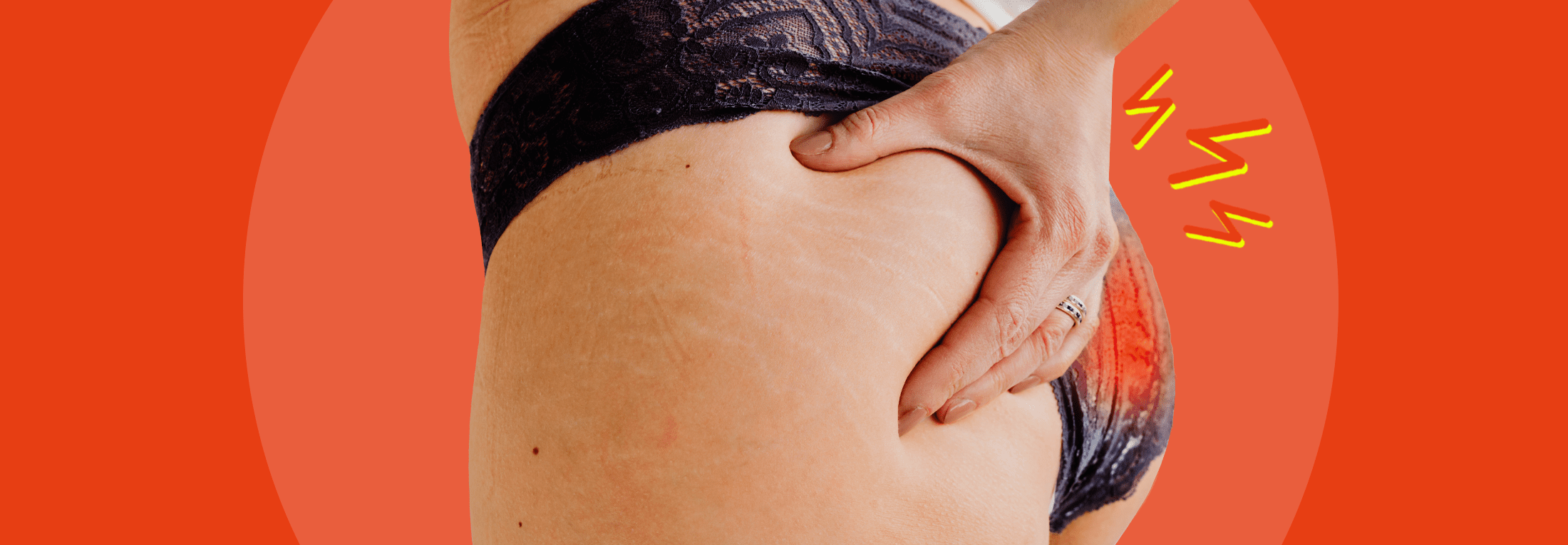
Not the “I need to poop” kind of pain. More like a sudden, intense cramp in your rectum or buttocks that makes you freeze and question everything. These are butt cramps, and yes, they’re a real period symptom.
Butt cramps, rectal pain during your period, and rectal cramps during menstruation are uncomfortable, strange, and surprisingly common. Here’s what’s actually causing them, and how to make them stop.
What causes butt cramps on your period?
Butt cramps are a type of referred menstrual pain. Say what? While period cramps start in the uterus, they don’t always stay there.
During menstruation, your body releases prostaglandins, hormone-like compounds that trigger uterine contractions to help shed your lining. These prostaglandins don’t just act on the uterus but can also affect nearby organs and muscles in the pelvis.
That includes:
- The rectum and anal canal
- The colon
- The gluteal muscles
- Shared pelvic and spinal nerves
As a result, uterine cramping can radiate outward, showing up as cramps in the buttocks, rectal cramps during menstruation, or sharp rectal pain during your period.
Rectal pain vs. butt muscle cramps
When people talk about butt cramps, they’re usually describing one (or both) of the following:
- Rectal or anal cramps: (AKA butthole cramps, rectal cramps, or proctalgia fugax). Sudden, sharp pain inside or around the rectum. This may feel like spasms, pressure, or stabbing pain and is often linked to prostaglandins affecting rectal muscles and nerves.
- Gluteal muscle cramps: A deeper ache or cramping sensation in the butt cheeks, caused by referred pelvic pain or muscle tension.
The good news is that both are normal period pain patterns.

What to know about IBS and rectal sensitivity
If you’re (one of many) women with IBS, rectal pain during your period may feel more intense. Research by Dr. L. A. Houghton found that rectal sensitivity increases during menstruation in people with IBS, but not in healthy individuals.1 This helps explain why rectal cramps during menstruation are especially common in people with existing bowel sensitivity.
Separate research by Brinkert et. al. also found that during menstruation, the rectum becomes more sensitive. This increased sensitivity can make everyday sensations feel painful, even in people without a diagnosed digestive condition.2
How common are butt cramps and rectal pain during menstruation?
There aren’t large studies that focus only on butt cramps. But we do know that gastrointestinal and pelvic symptoms during menstruation are extremely common.
One 2014 study found that 73% of menstruating people “experience at least one of the primary gastrointestinal (GI) symptoms either before or during menstrual bleeding,” with abdominal cramps and diarrhea standing out as the most common.3 Since the rectum is part of that system, it’s not surprising that pain sometimes shows up there too.
Between search data, social media, and clinical research on rectal sensitivity, it’s clear that rectal pain during your period and cramps in the buttocks are not rare, just under-discussed.
How to stop cramps in buttocks during your period
So, let’s get to the important bit: How to stop butt cramps during your period. The good news is that the same strategies that help period cramps can also help butt and rectal cramps.
Try these:
- Take an NSAID (like ibuprofen): These reduce prostaglandin production, which can ease uterine, rectal, and buttock cramping.
- Drink plenty of water: Dehydration can worsen muscle and smooth-muscle spasms, including those in the rectum.
- Use heat: A heating pad or warm bath can relax pelvic muscles and reduce rectal cramping.
- Gentle movement or stretching: Light walking or pelvic stretches can improve blood flow and reduce referred pain.
- Rest and sleep: Fatigue can amplify pain signals, making cramps feel worse.
- Orgasms: They release endorphins and can help relax pelvic floor muscles, sometimes relieving rectal pain.
- Eat gentle, gut-friendly foods: Research shows rectal sensitivity and GI symptoms increase during menstruation (especially for people with IBS), so focusing on easily digestible foods and limiting spicy, fatty, or bloating-prone foods may help reduce rectal pain and butt cramps.1
If butt cramps or rectal cramps during menstruation don’t improve with typical period pain relief, it’s worth checking in with a healthcare provider.
Rectal cramps during menstruation: Other symptoms & when to talk to a doctor
Occasional rectal pain during your period is usually normal. But you should talk to a healthcare provider if:
- Rectal cramps are severe or worsening each cycle
- Pain occurs outside of menstruation
- You notice major, persistent changes in bowel habits
- Pain interferes with daily life or doesn’t respond to treatment
People with IBS may be especially prone to rectal pain during menstruation due to hormonally driven increases in rectal sensitivity, as shown in research. Studies also suggest that dysmenorrhea itself is linked to increased rectal sensitivity.2
If something feels new, extreme, or different from your usual period experience, trust your instincts and get it checked.
This article is informational only and is not offered as medical advice, nor does it substitute for a consultation with your physician. If you have any gynecological/medical concerns or conditions, please consult your physician.
© 2026 The Flex Company. All Rights Reserved.
- Houghton, L. A. (2002). The menstrual cycle affects rectal sensitivity in patients with irritable bowel syndrome but not healthy volunteers. Gut, 50(4), 471–474. https://doi.org/10.1136/gut.50.4.471[↩][↩]
- Brinkert, W., Dimcevski, G., Arendt-Nielsen, L., Drewes, A. M., & Wilder-Smith, O. H. G. (2007). Dysmenorrhoea is associated with hypersensitivity in the sigmoid colon and rectum. Pain, 132(3), 257–262. https://doi.org/10.1016/j.pain.2007.01.029[↩][↩]
- Bernstein, M. T., Graff, L. A., Avery, L., Palatnick, C., Parnerowski, K., & Targownik, L. E. (2014). Gastrointestinal symptoms before and during mensesAnother term for menstrual flow (commonly known as your period). in healthy women. BMC women’s health, 14, 14. https://doi.org/10.1186/1472-6874-14-14[↩]