
Meet the A-spot: The deep(er) pleasure zone worth knowing about
IN THIS ARTICLE
The sexual pleasure landscape is full of famous landmarks. The clitoris. The G-spot. The positions everyone swears by. But tucked a little farther in (literally) is a lesser-known area that’s quietly earned a reputation for serious arousal: the A-spot.
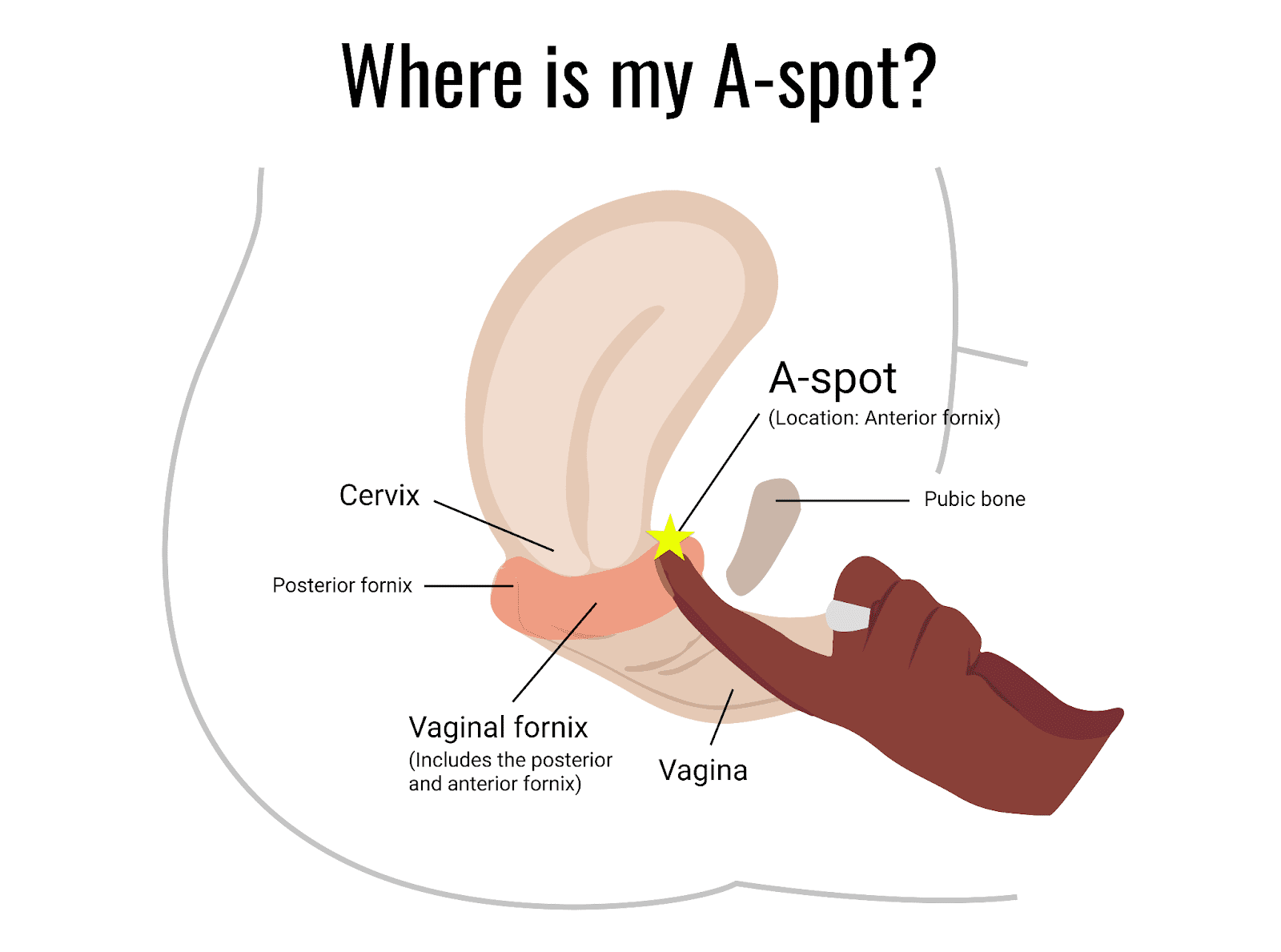
Short for the anterior fornix erogenous zone (AFE zone), the female A-spot sits deep along the front vaginal wall, closer to the cervix. It doesn’t get nearly as much attention as other pleasure zones, but research and real-world experience suggest it can play a meaningful role in arousal, lubrication, and even orgasm for some people.
Let’s break down what the A-spot is, where it lives, and what science (and sex therapists) actually say about it.
What is the female A-spot?
The A-spot is a sensitive area located on the front wall of the vagina, between the bladder and the cervix. Because it sits deeper than the G-spot, it is sometimes called a “deep spot.”
In research papers, this area is referred to as the AFE zone. A well-known study from 1997 looked at what happens when this area is gently and deliberately stimulated. The researchers found that many participants experienced increased natural lubrication and heightened sexual response, even if they had struggled with dryness or discomfort before.1
Put simply, the A-spot is not a myth. It is a real area of tissue that can respond to stimulation for some people (and, wink, produce fantastic orgasms).
Where is the A-spot located?
Here’s the easiest way to picture it:
- It is on the front wall of the vagina, on the same side as the belly
- It is deeper than the area people usually call the G-spot
- It is closer to the cervix, which sits at the end of the vaginal canal
Because everyone’s body is shaped a little differently, the exact location can vary. That’s one reason some people find it easily and others don’t notice much when exploring.
Why the G-spot debate matters here
Many guides explain the A-spot by saying something like “find the G-spot, then go a little deeper.” That sounds simple, but there’s an important reason this can be confusing.
A large scientific review published in 2021 looked at decades of research on the G-spot and found that scientists do not fully agree on whether it exists as a single, clearly defined structure. Some studies find a sensitive area. Others do not. Location and texture descriptions vary a lot.2
Interestingly, the review also showed that many people do feel something they describe as a G-spot. In surveys, about six out of ten participants reported having one, even though medical imaging and anatomy studies were inconsistent.2
This matters because it sets expectations. Internal pleasure areas can be very real in experience, even when science can’t point to one exact spot that looks the same in every body.
So, is the A-spot real?
Yes, with a caveat.
The 1997 AFE-zone study treated the A-spot as a specific stimulation area and measured physical responses. Many participants experienced strong lubrication, and a smaller group experienced orgasm during stimulation.1
A later case study from 2019 looked at people who experienced expanded sexual responses after exploring less familiar forms of stimulation, including deep vaginal stimulation. The takeaway was not that everyone will respond the same way, but that sexual response can change and broaden for some people over time.3
Together, these studies support a balanced view. The A-spot exists and can be pleasurable, but it is not a guaranteed button.
A-spot vs. G-spot in simple terms
Instead of thinking in strict labels, it can help to think in zones.
- The G-spot is usually described as a sensitive area on the front vaginal wall closer to the opening.
- The A-spot is described as a sensitive area deeper on that same wall, closer to the cervix.
The G-spot review introduces another helpful idea called the clitourethrovaginal complex. This is a way of explaining that pleasure may come from stimulating a group of connected tissues, not one tiny point.2
That explanation fits well with how many people describe A-spot pleasure, too.
What does A-spot stimulation usually feel like?
The A-spot doesn’t always feel obvious right away! People often describe it as:
- A deep pressure rather than a sharp sensation
- A feeling of fullness or warmth
- Something that becomes more noticeable as arousal increases
One consistent finding in research is lubrication. In the AFE-zone study, increased wetness often showed up early, before peak pleasure.1

A-spot orgasms and lubrication
Some people do experience orgasms linked to A-spot stimulation.
In the 1997 study, a portion of participants reported orgasm along with very strong lubrication.1 These orgasms were often described as deeper or more spread out through the body rather than sharp or localized.
That said, orgasm pathways vary widely. The A-spot is one option, not a requirement.
Does the A-spot cause squirting?
It can play a role, but it’s not that simple.
Research suggests that vaginal ejaculation, a.k.a. squirting, is linked to stimulation of the front vaginal wall as a whole, not one single spot. The G-spot review highlights how mixed and inconsistent the evidence is, even after decades of study.2
A realistic takeaway is that A-spot stimulation might be involved for some people, but it should not be framed as the single cause.
Positions that may make A-spot stimulation easier
Because the A-spot is deep, positions that allow deeper penetration and front-wall contact tend to work best:
- Doggy style, especially with a pelvic tilt
- Cowgirl while leaning back
- Missionary with hips elevated using a pillow
- For some, even anal penetration, which can indirectly press against the vaginal wall
Comfort and communication are especially important here, since the cervix is nearby. Of course, cervical orgasms are possible, too. 😉

Tips for exploring the A-spot comfortably
A few beginner-friendly guidelines:
- Use plenty of lubricant
- Go slow and let arousal build
- Focus on angle and pressure instead of speed
- Stop if anything feels painful or uncomfortable
- Consider longer toys if fingers do not reach comfortably
The expanded sexual response study supports the idea that learning what works can take time and experimentation.
Is A-spot pleasure for everyone?
No. Anatomy and sensitivity vary widely. Some people enjoy deep stimulation, while others don’t feel much or find it uncomfortable. Clinical research consistently supports this kind of variation in sexual response.
Takeaway: There is no one single correct reaction.
A little permission slip before you go
Before closing the tab and mentally adding “find the A-spot” to a future to-do list, here is the most important thing to remember: curiosity counts as success.
The A-spot does not need to produce fireworks, instant orgasms, or a dramatic personality shift in the bedroom to be worth exploring. Sometimes the win is simply noticing a new sensation. Sometimes it is realizing that deep stimulation is not your thing. Sometimes it is learning that arousal builds more slowly, or differently, than expected.
Research helps explain what can happen, but it does not get to decide what should happen. Bodies are not performance-based systems, and pleasure isn’t a scavenger hunt with a prize at the end.
So if exploration feels fun, follow that thread. If it feels awkward, boring, or distracting, that is useful information too. The real takeaway is not “everyone should love the A-spot.” It’s that there are more options available than most of us were ever taught, and you get to decide which ones deserve a second date.
This article is informational only and is not offered as medical advice. It is not a substitute for a consultation with your physician. If you have any gynecological/medical concerns or conditions, please consult your physician.
© 2026 The Flex Company. All Rights Reserved.
- Chua, C. A. (1997). A proposal for a radical new sex therapy technique for the management of vasocongestive and orgasmic dysfunction in women: The AFE zone stimulation technique. Sexual and Marital Therapy, 12(4), 357–370. https://doi.org/10.1080/02674659708408179[↩][↩][↩][↩]
- Vieira-Baptista, P., Lima-Silva, J., Preti, M., Xavier, J., Vendeira, P., & Stockdale, C. K. (2021). G-spot: Fact or fiction? A systematic review. Sexual Medicine, 9, 100435. https://doi.org/10.1016/j.esxm.2021.100435[↩][↩][↩][↩]
- Sayin, H. U. (2019). Five cases with expanded sexual response (ESR). Annals of Clinical Case Studies, 1(1), 1005.[↩]